 ultimate-guide
9 Modern Farmhouse Design Trends for Augusta Homes
Last Updated: October 25, 2026
Quick Summary
Modern farmhouse design in Augusta is shifting toward warmer exterior palettes, mixed materials like natural stone, and collected interiors over staged rooms. The style pairs clean contemporary lines with rustic elements such as board-and-batten siding and metal roof accents, and it accounted for 33% of house-plan sales in 2025.
- Modern farmhouse plans made up 33% of house-plan sales in 2025, the most requested design category nationally.
- Choose two exterior materials and let one lead so the facade does not look busy.
- Specify fiber cement siding over wood where budget allows because it resists moisture and termites.
- Keep the sink, range, and refrigerator within a few steps of each other in the kitchen layout.
- In historic homes, assess and stabilize the envelope before any cosmetic work begins.
Table of Contents
- Why Modern Farmhouse Design Still Dominates Augusta Home Plans
- 9 Modern Farmhouse Design Trends Shaping Local Homes
- Modern Farmhouse Exterior Design That Handles Southern Humidity
- Modern Farmhouse Color Schemes Moving Toward Warmth
- Modern Farmhouse Interior Design Ideas for Real Family Life
- Modern Farmhouse Kitchen Ideas That Age Well
- Updating a Historic Home Without Erasing Its Character
- Plan Your Modern Farmhouse Build With RTS Builders, LLC
- Frequently Asked Questions
Why Modern Farmhouse Design Still Dominates Augusta Home Plans
Modern farmhouse design trends in Augusta keep winning because the style solves a real problem: it lets a new home feel warm and established without pretending to be a century-old house. For a deeper look at local home-building considerations, see our Augusta custom home guide. According to Houseplans Blog's house plan trends report, modern farmhouse plans accounted for 33% of house-plan sales in 2025, making it the most requested design category in the country.
Modern farmhouse is a design style that pairs clean, contemporary lines with rustic, traditional elements like board-and-batten siding, metal roof accents, and natural wood. It is not a single look. That flexibility is the point.
Below, we break down the nine trends shaping local homes right now, plus the material choices that survive Georgia humidity.
9 Modern Farmhouse Design Trends Shaping Local Homes
These nine trends reflect where the style is heading, drawn from current design reporting. The short version: less black-and-white contrast, more warmth, and rooms that feel lived in rather than staged.
- Warmer exterior palettes replacing stark black and white
- Mixed materials and natural stone
- Collected interiors over staged rooms
- Humidity-conscious exterior detailing
- Earthy, layered color schemes
- Adaptable layouts for real family life
- Kitchens with durable, timeless finishes
- Character-preserving updates to historic homes
- Handcrafted and vintage accents used sparingly
Warmer Exterior Palettes Replace Stark Black and White
The high-contrast farmhouse look is fading. Houseplans Blog's 2026 trend report describes a shift away from the stark black-and-white palette toward warm, grounded hues and natural variation. In practice, that means warm white siding, greige trim, and muted sage or clay accents instead of jet-black windows. The result reads softer and holds up better under a strong Southern sun.
Mixed Materials and Natural Stone
Stone, board-and-batten, and vertical siding now share the same facade. Houseplans Blog identifies natural stone paired with mixed exterior materials as a defining direction for the style. The trick is restraint: pick two materials and let one lead. Three or four competing textures on one elevation starts to look busy.
Collected Interiors Over Staged Rooms
Design reporting from the Julie Provenzano Group design report points to warmer palettes, layered textures, and rooms that feel collected instead of staged. Translation for a new build: leave space for the pieces a family already owns. A perfectly coordinated showroom interior dates fast. A room with a vintage rug and an inherited dining table does not.
Modern Farmhouse Exterior Design That Handles Southern Humidity
Modern farmhouse exterior design in this climate lives or dies on moisture management. Augusta summers push humidity high enough that the wrong material choice shows up as rot, mold, or peeling paint within a few seasons.
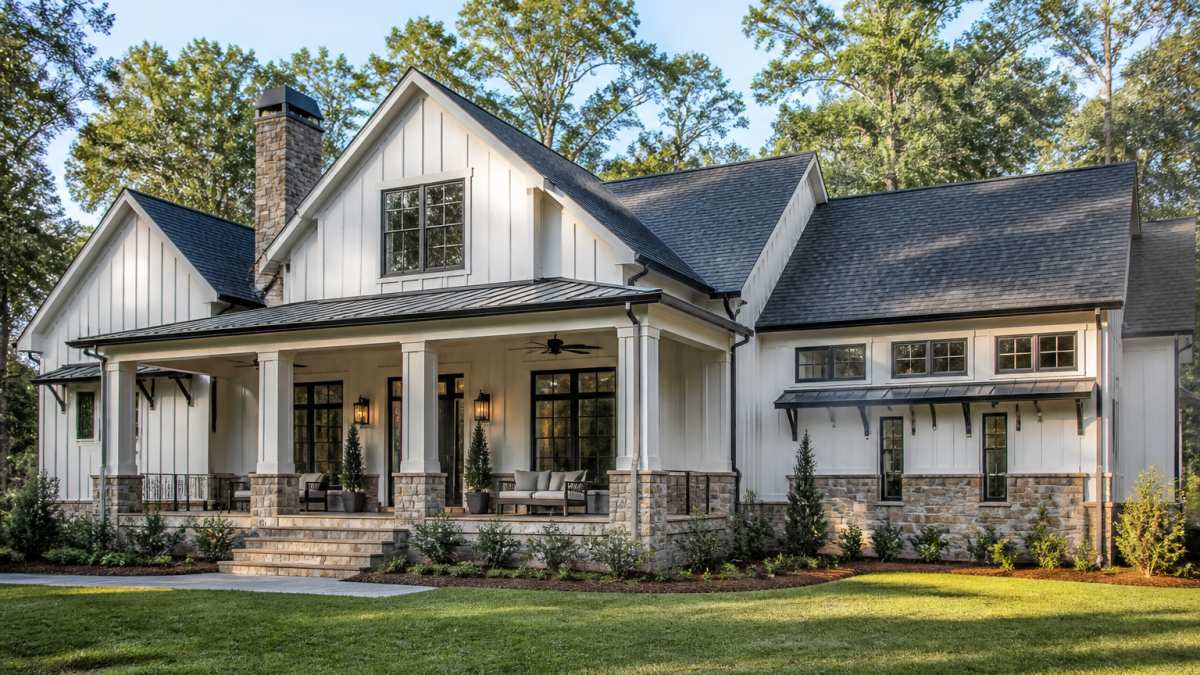
Here is what we specify and why:
- Fiber cement siding over wood where budget allows, because it resists moisture and termites
- Pressure-treated framing at porches and anywhere wood meets masonry
- Vented soffits and proper roof pitch to move attic moisture out
A common mistake is copying a farmhouse elevation from a drier market without adjusting the details.
Modern Farmhouse Color Schemes Moving Toward Warmth
Modern farmhouse color schemes are shifting from cool gray and bright white toward earthy, warm tones. The 2026 design direction favors grounded hues that connect the interior to the landscape rather than fighting it.
A workable palette for a home:
| Element | Color Direction | Why It Works Here |
|---|---|---|
| Main siding | Warm white or soft cream | Reflects heat, stays classic |
| Trim and windows | Greige or warm charcoal | Softer than black, less harsh |
| Accent siding | Sage, clay, or muted olive | Ties to surrounding greenery |
| Interior walls | Warm off-white, oatmeal | Forgives humidity-driven sheen |
| Cabinets | Natural oak or warm painted | Ages without dating |
The old black-window-on-white-siding formula is not wrong, exactly. It is just everywhere, and it is starting to look like a catalog rather than a home.
Modern Farmhouse Interior Design Ideas for Real Family Life
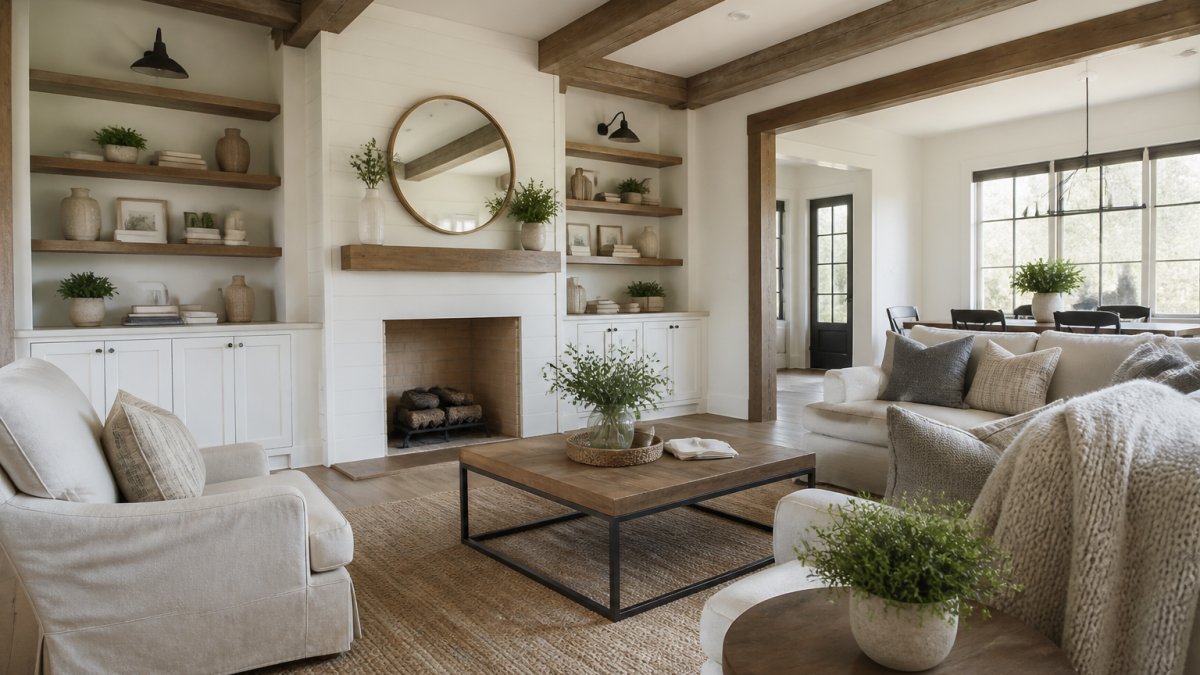
Modern farmhouse interior design ideas work best when they start with how a family actually lives, not how a photo looks. Design commentary from Canopy Floors on evolving floor plans notes that wide-open plans are evolving into more intimate, cozy spaces, alongside exposed wood beams, patinated metals, and subtle shiplap.
That shift matters for growing families. A single vast great room looks impressive and functions poorly once kids, homework, and noise enter the picture. We recommend:
- A defined dining room or nook separate from the main living space
- Shiplap used on one wall or a fireplace surround, not every surface
- Exposed beams in the main living area for warmth without clutter
Shiplap, barn doors, and galvanized metal all at once turns a home into a theme. Pick two signature farmhouse elements and let the rest stay quiet.
Modern Farmhouse Kitchen Ideas That Age Well
Modern farmhouse kitchen ideas should be judged on how they look in year ten, not year one. The kitchen is the most expensive room to redo, so the goal is finishes and a layout that stay current and survive daily cooking. The useful version covers layout, moisture, storage, and where the money actually goes.
Start With the Layout, Not the Cabinet Color
A modern farmhouse kitchen works because it hides the work. The style's open shelving and statement hoods photograph well, but the functional decisions come first:
- Work triangle or work zone: Keep the sink, range, and refrigerator within a few steps of each other. In an open plan, a perimeter run plus one island usually beats a single long wall.
- Island sizing: An island needs roughly 36 inches of clearance to surrounding counters for a single cook, and more where two people pass each other. A too-large island is the most common open-plan regret.
- Pantry and landing space: Farmhouse style implies bulk cooking and gathering. A walk-in or deep reach-in pantry, plus counter space beside the range and fridge, matters more than a decorative hood.
Finishes That Age Well in a Humid Climate
- Shaker-style cabinets in a warm paint or natural wood outlast trendier profiles. Flat-panel and slab doors look sharp but show every fingerprint and seam.
- Quartz or quartzite counters over marble in a busy family kitchen, for stain and etch resistance. Marble is beautiful and unforgiving around citrus, wine, and everyday spills.
- A large single-basin sink with a durable composite or fireclay finish. Fireclay resists chipping and heat; composite handles impact better. Both beat thin-gauge stainless for a farmhouse look.
Where the Budget Actually Goes
Kitchen budgets vary widely by size, layout changes, and finish level, so treat any single number with suspicion. A way to plan is to rank spending in this order:
- Layout and infrastructure, moving walls, plumbing, and electrical is where budgets disappear. Get the plan right before choosing finishes.
- Counters and hardware, the surfaces you touch every day. If money is tight, spend here first.
- Cabinets, durable boxes and hardware matter more than a trendy door profile.
- Appliances and hood, buy for function and serviceability, not just the look.
- Decorative details, open shelving, vintage lighting, and styling come last and are the easiest to change later.
The honest limitation: natural wood cabinets show wear in a hard-working kitchen, and painted cabinets show chips at high-use corners. Neither is a dealbreaker, just plan for touch-ups and choose a finish sheen that hides daily life.
Updating a Historic Home Without Erasing Its Character
Updating a historic home means adding modern function while keeping the architectural details that give it value. In older homes across the area, that usually means respecting original trim, floors, and window proportions rather than covering them. The practical version is a sequence: assess, stabilize, modernize, then decorate.
A Four-Step Framework
1. Assess what you actually have. Before any demolition, document original trim profiles, door and window sizes, flooring, and any distinctive hardware.
2. Stabilize the envelope first. Older homes leak air and moisture in ways that make every finish decision moot.
3. Modernize systems and comfort. Electrical, plumbing, and HVAC upgrades drive most renovation requests.
4. Introduce farmhouse elements last. Bring the style in through furniture, lighting, and paint rather than demolition.
Where to Draw the Line
- Keep original hardwood and trim where it is structurally sound. Refinish rather than replace.
- Match new millwork profiles to the existing house, not to a catalog. A good millwork shop can replicate a profile from a sample.
- Additions should read as secondary to the original structure, set back, lower massing, or a clearly differentiated material.
Climate and Code Realities
Older homes were built before modern energy and moisture standards, and that cuts both ways. They often ventilate differently than new construction, so sealing one area can trap moisture elsewhere. A common pattern is to tighten the envelope and add mechanical ventilation at the same time rather than one without the other. Any structural, electrical, or plumbing change also triggers permitting and inspection, so confirm requirements with the local building authority before work begins.
If you are weighing a character-preserving update, our home renovations and remodeling services cover how that work is scoped and sequenced.
Plan Your Modern Farmhouse Build With RTS Builders, LLC
Getting the style right starts with the plan and the builder, not the paint chip. Learn more about our custom home building services.
Before you commit, it helps to understand the sequence and timing. Our custom home building timeline walks through the process from planning to move-in. When you are ready to talk, you can reach our team for a project consultation. Visit our RTS Builders contact page to get started.
Frequently Asked Questions
Can you describe the modern farmhouse style of design?
Modern farmhouse blends rustic warmth with clean contemporary lines. You will see board-and-batten or shiplap walls, exposed wood beams, natural stone, and vintage-style lighting paired with simple, uncluttered layouts. The 2026 version leans warmer than the black-and-white look that defined the style for years. Houseplans Blog reports that modern farmhouse plans made up 33% of house-plan sales in 2025, and the category is now moving toward warm, grounded hues and natural variation rather than a uniform staged look.
How can you make modern farmhouse interiors feel current rather than dated?
Skip the matching set. Design commentary cited for 2026 describes interiors shifting toward warmer palettes, layered textures, and rooms that feel collected instead of staged. In practice, that means mixing wood finishes, adding vintage pieces alongside new furniture, and using shiplap or wall panels as an accent rather than covering every wall. Open layouts are also evolving toward more intimate, cozy zones, so define spaces with furniture and lighting instead of knocking down every wall.
What materials are commonly used in modern farmhouse design?
Reclaimed and natural materials do most of the work: rustic wood beams, wood finishes on floors and ceilings, natural stone, board-and-batten siding, and handcrafted elements like custom cabinetry or metal fixtures. In the Augusta climate, material choice matters as much as looks. Humidity and summer heat punish poor ventilation and moisture-trapping assemblies, so durable finishes and correct flashing and drainage should be settled before you pick a paint color.
How can you add modern farmhouse style without a full renovation?
Start with the changes that carry the most visual weight: paint colors, vintage-style lighting, and one accent wall in shiplap or wall panels. Swapping hardware and adding rustic wood shelving or a reclaimed mantel delivers the farmhouse feel for far less than a remodel. If you are planning a larger change, such as a home addition or kitchen renovation, bring a contractor in early so the design decisions and the construction schedule line up from the start.
The hardest part of a modern farmhouse build is not choosing a color palette. It is holding the details together across framing, siding, moisture control, and finishes so the house still feels warm five years in. RTS Builders, LLC brings licensed oversight, over a decade of construction experience, and a hands-on approach with clean, organized job sites and projects kept on schedule. Get started with RTS Builders, LLC and build a home with character that holds up.